10 Best Feature Request Software for SaaS Teams (2026)
Compare 10 feature request tools by AI, pricing, and integrations. ProductBridge at flat $29/mo — AI feedback auto-collection, roadmaps, changelogs included.
Product Management

Product teams receive their feature requests from multiple sources, like email, Slack, support tickets, sales calls, in-app messages, customer interviews, and many other similar platforms. It is difficult for teams to keep switching platforms to review the feedback.
Feedback management tools and feature request trackers solve this problem by centralizing the feedback from multiple sources in one platform, allowing teams to prioritise feature requests, build roadmaps, and announce releases to their important users.
TL;DR
ProductBridge is one of the top feature request software tools in 2026 with strong AI capabilities, feedback management, and advanced functionalities. Along with ProductBridge, some top choices include Canny, Featurebase, Productboard, Upvoty, etc.
Key Takeaways
ProductBridge is one of the best feature request software and customer feedback management tools with strong AI assistance.
Canny and Featurebase also offer AI capabilities in feedback management, but are limited to basic functionalities.
Savio is a feature request software that is a good choice for those teams that need revenue-weighted prioritization.
Frill and Upvoty are suitable for early-stage teams with their clean user interface.
Usersnap offers AI capabilities along with feedback management, roadmaps, and a changelog. Sleekplan is a feature request management tool that offers a free plan permanently. However, it has limited AI capabilities.
Jira Product Discovery offers direct integration with Jira and allows teams to connect discovery to delivery.
Productboard is a full suite of product management with feedback management and product planning.
10 Best Feature Request Software Tools in 2026
The following best feature request management tools are picked based on feature depth, functionality, pricing structures, team size compatibility, and real value to customers.
1. ProductBridge
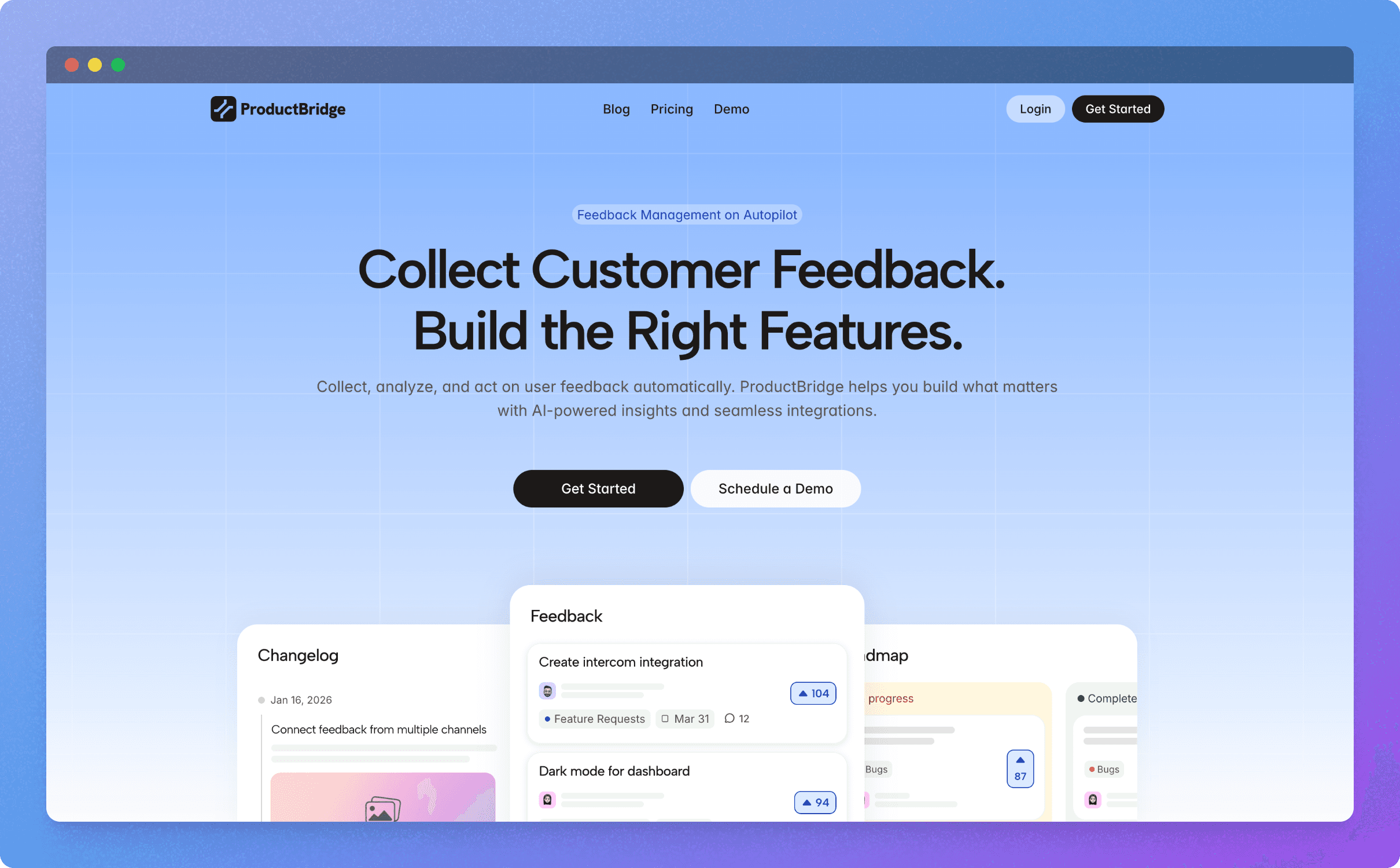
ProductBridge is a strong AI-backed feature request tracking tool that offers robust AI capabilities, feedback collection, organization, prioritization, roadmaps, changelogs, and many more internal required features to help teams of all sizes build a great product.
Key Features
Public, private, segment-based boards
Trend detection using AI
Product Roadmaps — both private and public
AI-written changelog
Multiple SaaS tools integrations
Predictable and affordable pricing
Sort requests by MRR (Monthly Recurring Revenue)
Multiple organizations handling
Pros
Strong AI assistance
Upvotes and prioritization signals
Custom status workflows
Roadmap alignment
Cons
Advanced AI might not suit teams that need simple management
Pricing
Plan | Pricing | Features |
Free | Free | 1 feedback board, public roadmap, changelog, 100 tracked users, AI duplicate detection |
Starter | $29/month billed yearly ($39 billed monthly) | Unlimited tracked users, unlimited boards, all integrations, autobridge AI, auto-ingestion (2 sources) |
Growth | $59/month billed yearly ($69 billed monthly) | Unlimited team members, advanced features than the Growth plan, SSO/SAML, unlimited auto-ingestion |
Enterprise | Custom | Dedicated success manager, SLA & security audit, SOC 2 & custom invoicing, custom integrations |
2. Canny
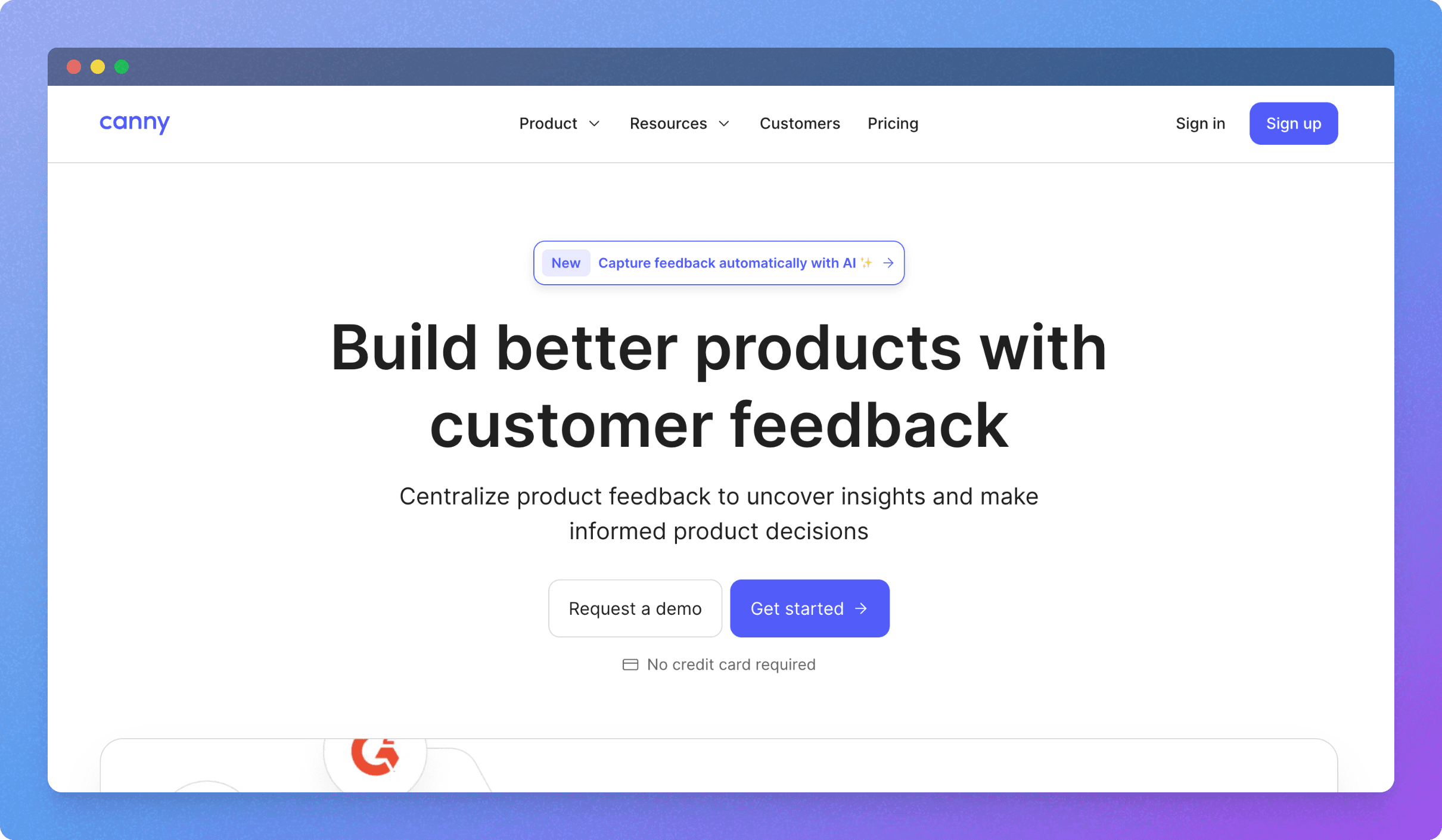
Canny is a popular feature request software that has well designed feedback loop from user request submission to receiving automatic notifications on shipped features. It also offers basic AI assistance that is limited to ingestion, not deep trend analysis.
Key Features
Feedback capture with AI
Customer support tools integration
Customized prioritization formula
Project Management tools integration
Roadmaps for specific projects
Automatic notifications on shipping features
Smart replies with AI
Pros
Public or private roadmaps
HubSpot or Salesforce properties syncing
Feedback portal on site
Content summaries
Cons
Basic AI capabilities
Unpredictable pricing, it scales as users grow
Advanced features hid behind higher tiers
Pricing
Plan | Pricing | Features |
Free | Free | 25 tracked users, unlimited posts, and automatic feedback capture |
Pro | $79 /month billed yearly | 100+ tracked users, PM integrations, and advanced privacy |
Business | Custom | 5000+ tracked users, SSO integrations, CRM integrations |
3. Featurebase
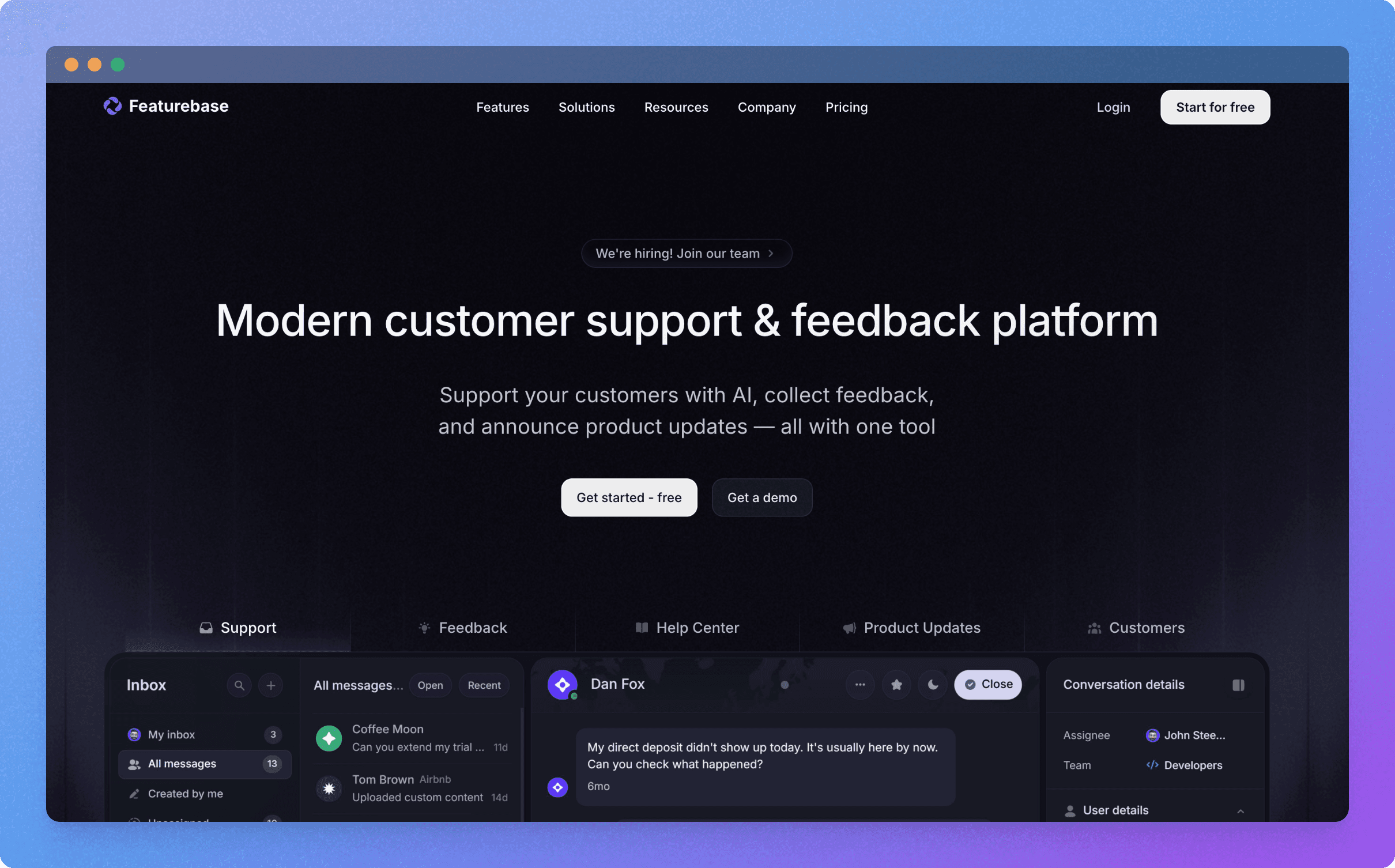
Featurebase is a widely used feature request software that allows users to build a roadmap with transparency. It focuses on allowing teams to communicate with users publicly, to deliver the best possible results as quickly as possible. Featurebase’s AI organizes the user feedback and creates a single workflow.
Key Features
In-app widgets
Fibi AI for customer support
Automatic notifications on shipping features
Multiple tools integrations
Multi-brand and multilingual
Release segmentation
Product feedback communities
Pros
Public feedback infrastructure
AI-powered organization
Segmentation and targeting
Public changelog, in-app widgets
Cons
Advanced enterprise features are limited
No impact-based prioritization
Limited customization options
Pricing
Plan | Pricing | Features |
Free | Free | Live chat, feedback & roadmaps, help centre up to 50 articles, surveys, unified inbox & ticketing |
Growth | $29 /seat/month, if billed yearly $37 /seat/month, otherwise | Fibi AI, email support, custom domains, integrations, AI replies & macros |
Professional | $59 /seat/month, if billed yearly $75 /seat/month, otherwise | Workflows and automations, API & webhooks, Slack support, round robin assignment |
Enterprise | $99 /seat/month, if billed yearly $129 /seat/month, otherwise | Custom admin roles, admin SSO login, advanced HubSpot integration, personalized onboarding, and custom invoicing |
4. Savio
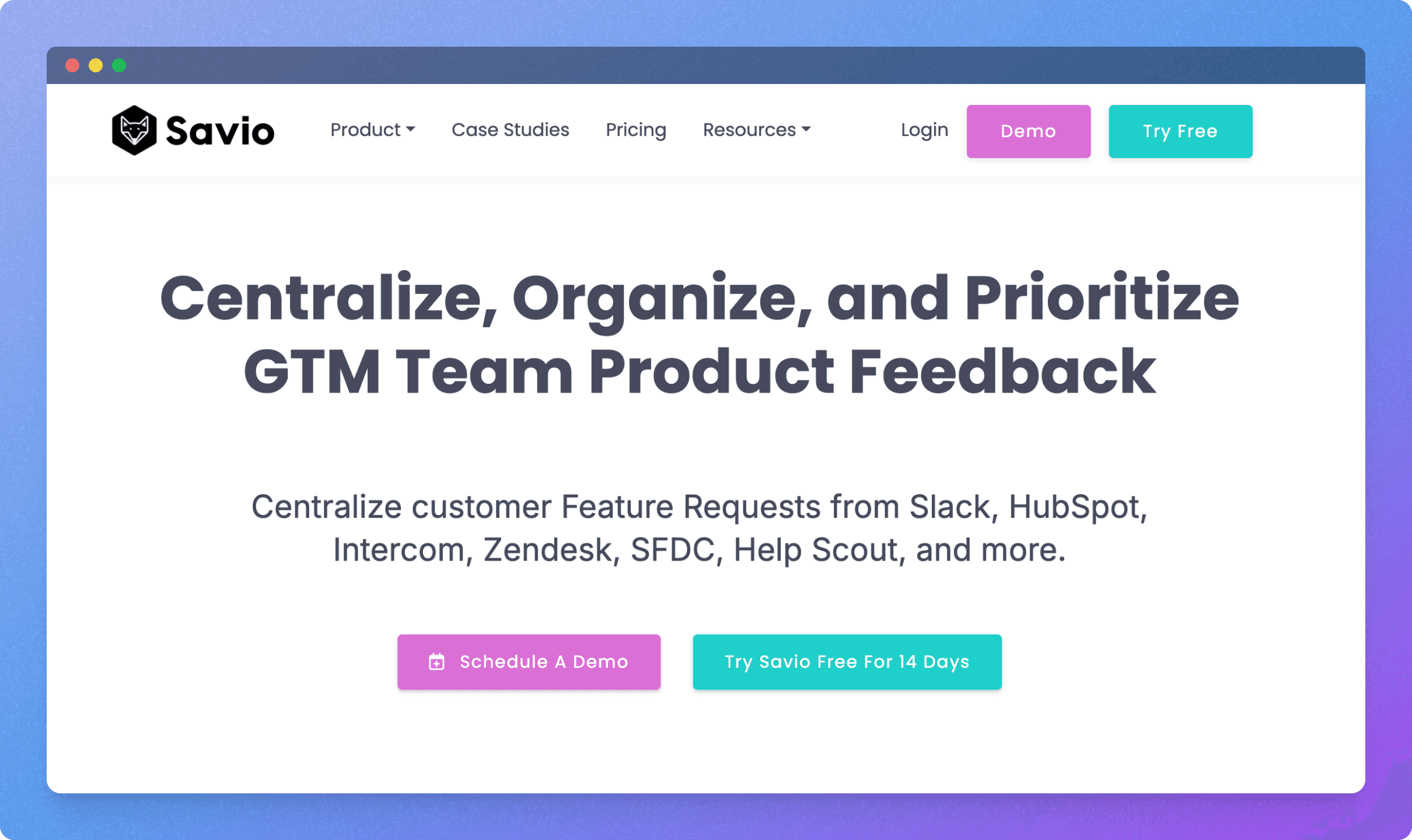
Savio is a feature request management tool that centralizes, organizes, and prioritizes GTM team product feedback. It helps teams in collecting and prioritizing feature requests, build evidence based roadmaps, and product planning.
Key Features
Revenue-weighted prioritization
Feature request trends analysis
Revenue data linked roadmaps
Native integrations with multiple popular tools
Development buy-in tool
Development issues status visibility
Pros
Quick setup
CRM-enriched and revenue-focused prioritisation
Two-way development tool sync (Jira and Shortcut)
Customer-evidence backed roadmaps for stakeholders
Cons
No AI-powered features
No free tier available
The customer-facing voting board is limited
Pricing
Plan | Pricing | Features |
Essential | $39/month, if billed annually $49/month, if billed monthly | Centralize feedback, triage feedback, close the loop, 1 roadmap, unlimited free users |
Professional | $79/month, if billed yearly $99/month, otherwise | Customer segmentation, 5 roadmaps, product areas, along with Essential’s features |
Business | $249/month, if billed annually, $299/month, if billed monthly | Multiple products, unlimited roadmaps, Segment integration |
Custom | Contact | Priority support, Customer DPA, Customer onboarding and enablement, etc. |
5. Upvoty
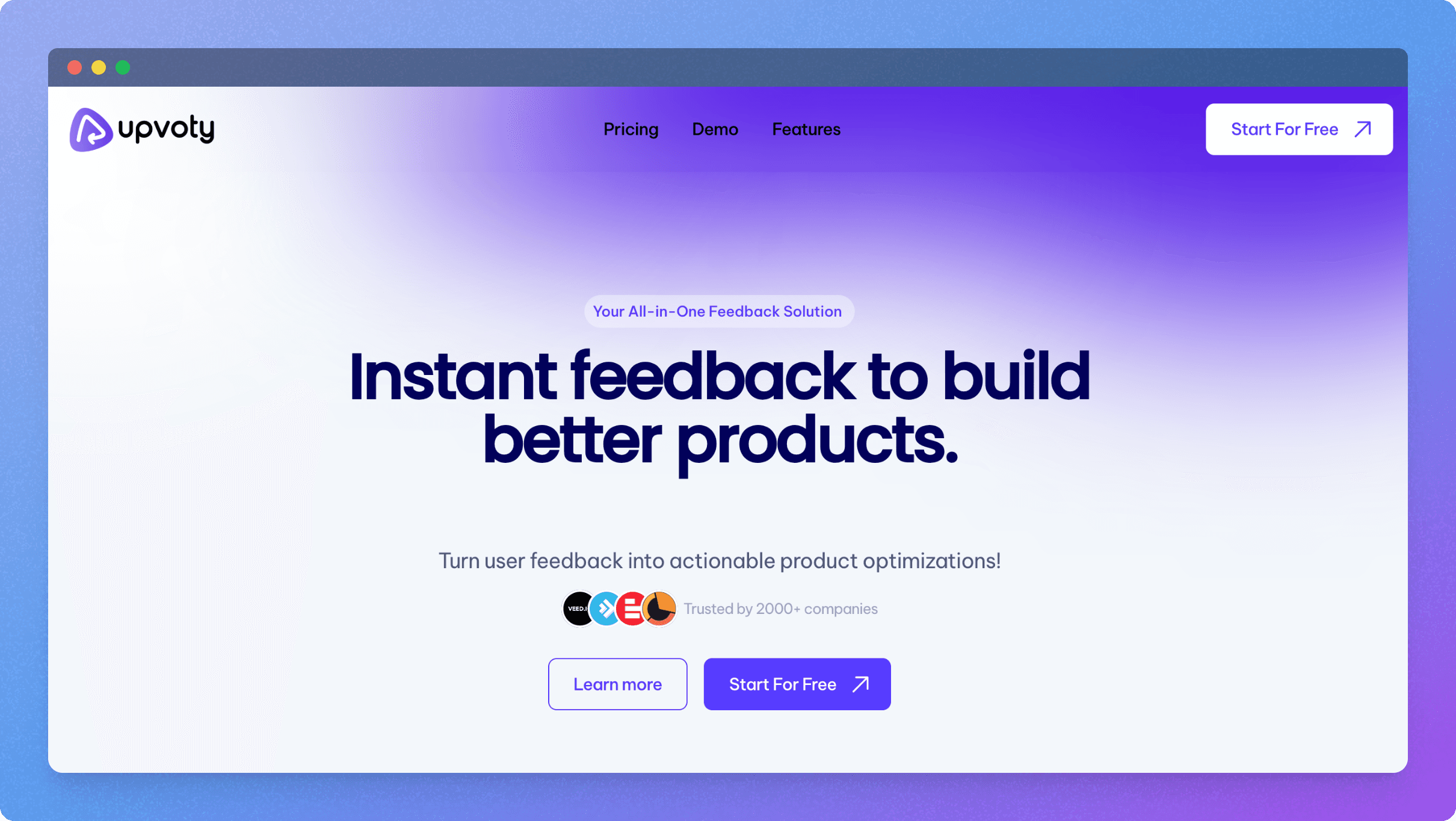
Upvoty is a feature request management tool that comes with a user-friendly interface. It provides feedback boards for users to write their ideas on. It follows a structured workflow and is suitable for startups and mid-sized teams.
Key Features
Private or public feedback boards
Customizable roadmaps with voting
Custom domain feedback collection
Changelog announcements
Embeddable widgets
Integrations with multiple platforms
Feature voting, leaderboard, tags
Pros
Easy to set up and user interface
Merge AI to merge duplicate posts easily
Customizable presentation
Public feedback infrastructure
Cons
Lack of AI capabilities
Limited automation layers
Advanced prioritization layers
Pricing
Plan | Pricing | Features |
Power | $15 /month | 1 project, unlimited boards, unlimited users, custom domain |
Super | $25 /month | 1 project, unlimited boards, unlimited users, custom categories, user segmentation, all integrations |
Hyper | $49 /month | Unlimited projects, unlimited boards, custom domain, all integrations, unlimited users |
6. Frill
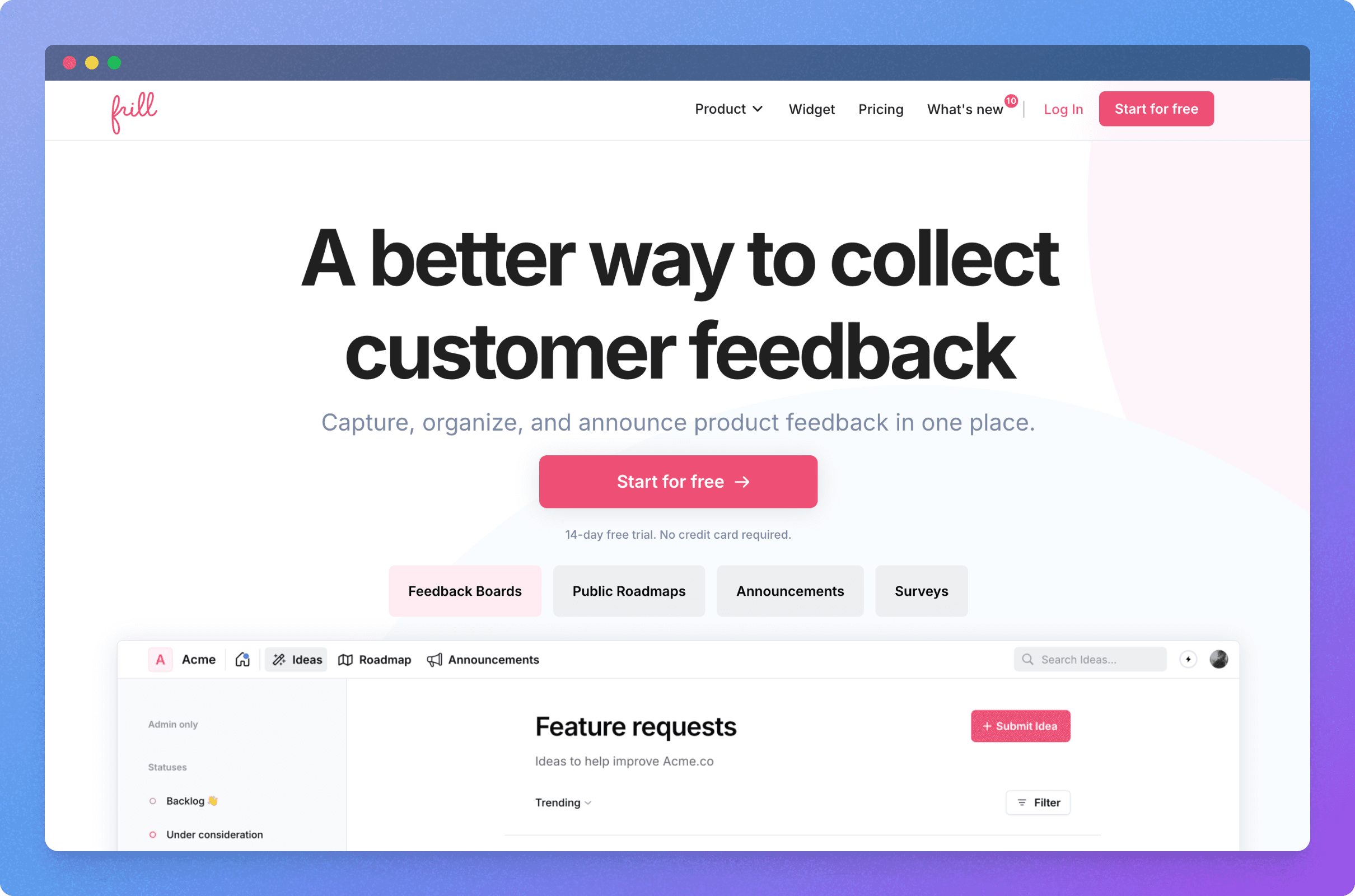
Frill is a feature request tracker tool that is lightweight, yet offers a clean and easy-to-use interface along with simple public boards. It does not involve enterprise-level complexity but is designed to help growing teams in early stage.
Key Features
Both the web app and the widget are available
Feedback boards with upvotes
Topic-wise boards for idea posting
Unlimited widget creation
Brand customization
Automated emails to update status
Inline admin feature
Pros
Customizable roadmaps
Fully featured changelogs
Fully translatable feedbacks
Surveys and announcement
Cons
No advanced segmentation and automation
Not suitable for mid-to-large-sized teams
Not suitable for product development, only for a feedback voting system
Pricing
Plan | Pricing | Features |
Startup | $25 /month | 50 ideas, 1survey, etc. |
Business | $49 /month | Unlimited ideas,3 surveys, etc |
Growth | $149 /month | Unlimited ideas, privacy, surveys, white labelling |
Enteprise | $349 /month | Dedicated support, SOC2 compliance, Audit logs, IP whitelisting, Dedicated hosting |
7. Usersnap
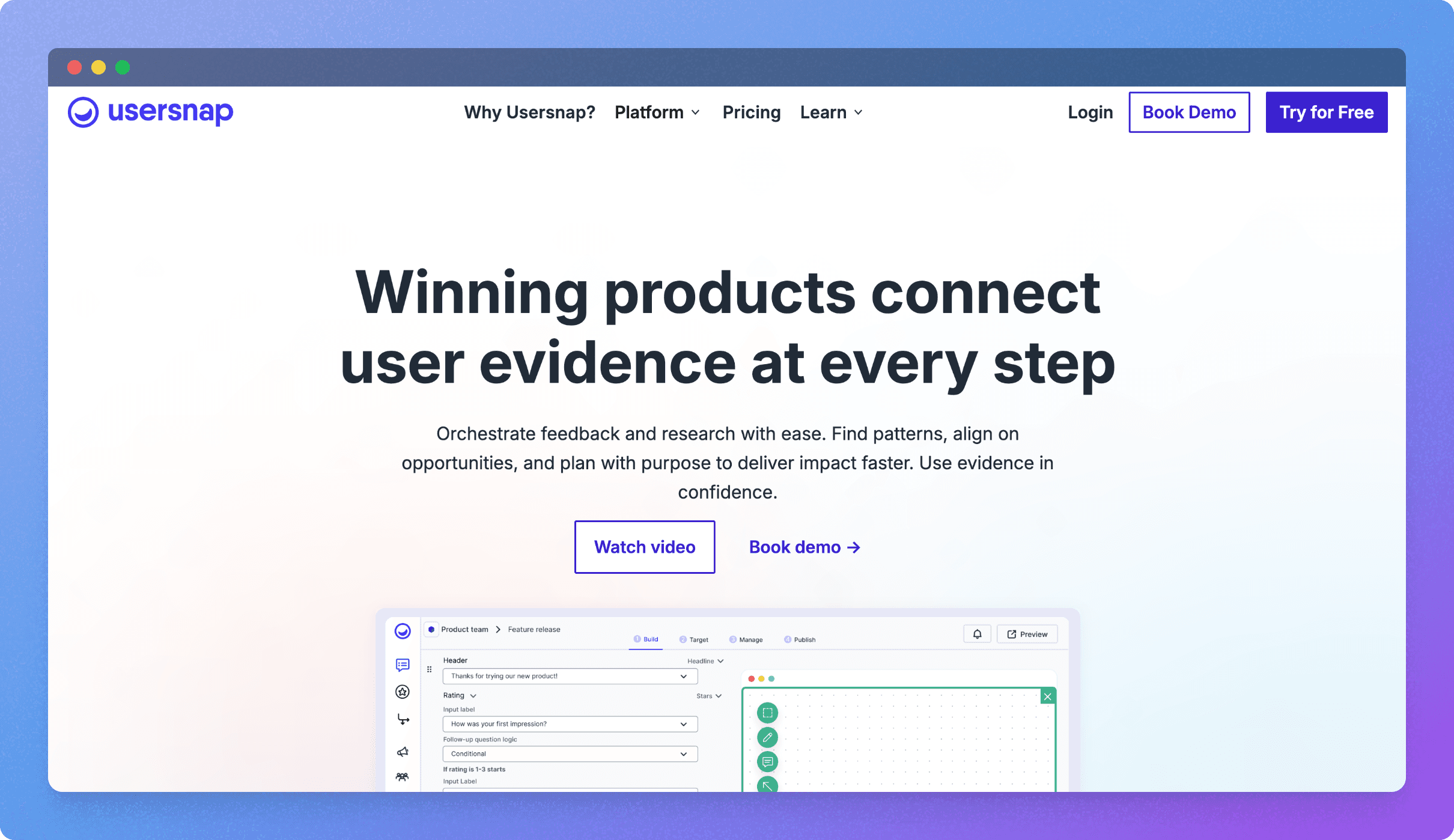
Usersnap is a feature request platform that allows team members within an organization to create requests and provides a means for managing their collective feedback/research processes successfully.
They also help identify trends related to your various project opportunities, as well as facilitating management of your project's timeline or strategic direction. In addition, Usersnap uses AI tools that can reduce the amount of time required for your team to complete a given task.
Key Features
AI-powered feedback categorization
Channels data ingestion
Requests, sentiment, and segment monitoring
Real-time charts, conditional responses, and topics
User satisfaction scores, bug resolution time
Kanban-style idea boards
Multiple platform integration
Pros
No pay per seat to invite teams
AI capabilities
Guided scoring process to prioritize
Ratings and follow-up emails
Cons
Expensive for early-stage teams
Branding will be there, except on the highest tier
Limited widget customization
Pricing
Plan | Pricing | Features |
Free | $0/month | Collect feedback, solve user problems. The first 20 feedback items are free |
Starter | $39/month | Screen capture widgets, opportunity board, announcements |
Growth | $89/month | Feedback and support menu, conditional questions, reply follow-ups, and AI sentiment sensor |
Professional | $159/month | Customer request portal, error console logs, behavioral targeting, and segment identification |
Premium | $319/month | Custom branding, mobile SDK, multi-lingual translations, roles & permissions |
8. Sleekplan
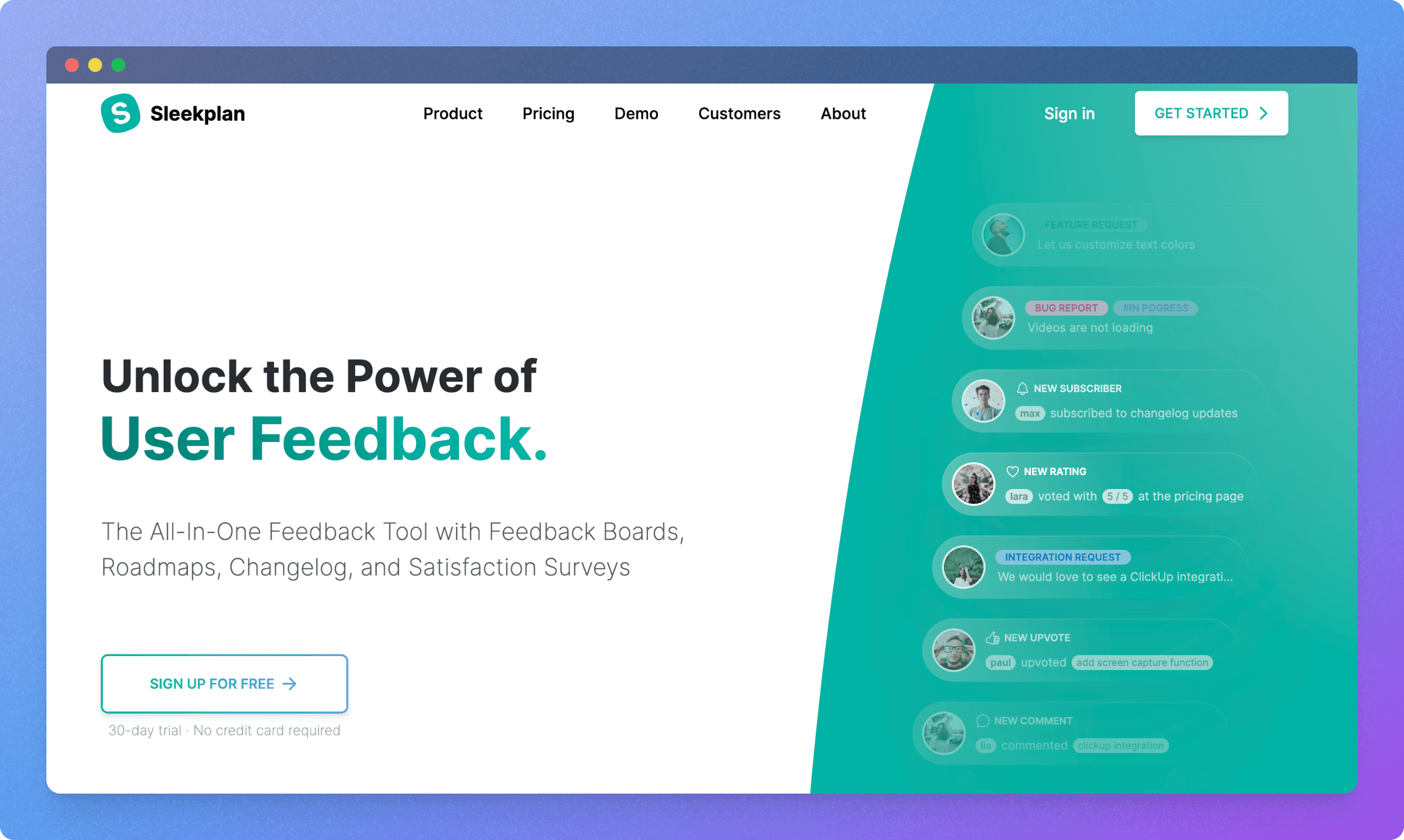
Sleekplan is a feature request management tool that allows you to manage your customers' feedback, track their satisfaction and close the feedback loop by taking advantage of sentiment analysis and structured visibility. The tool also provides you with a way to view what is on your development roadmap and analyze customer intent. It includes minimal automation capabilities.
Key Features
Public and private feedback boards
User Feedback board widget
Anonymous voting and posting
User notifications on changing the status
Customizable impact scoring for your feedback
Customer satisfaction scores
Multi-step surveys, conditional questions, and targeting
Pros
Feedback grouping
Customizable roadmaps
Built in CSA and NPS surveys
In-app feedback
Cons
Limited AI capabilities
No deep CRM integration
Vote-count based prioritization
Pricing
Plan | Pricing | Features |
Indie | Free | Unlimited end-user, unlimited feedback, unlimited subscriber, 1 team seat, feedback board, changelog |
Starter | $15 /month, $13 /month if annually billed | Feedback board, changelog, roadmap, customer satisfaction, net promoter score |
Business | $45 /month, $38 /month, if annually billed | Unlimited tracked users, feedback, subscriber and all in the starter plan |
Enterprise | Custom | Unlimited team seats + everything in business |
9. Jira Product Discovery
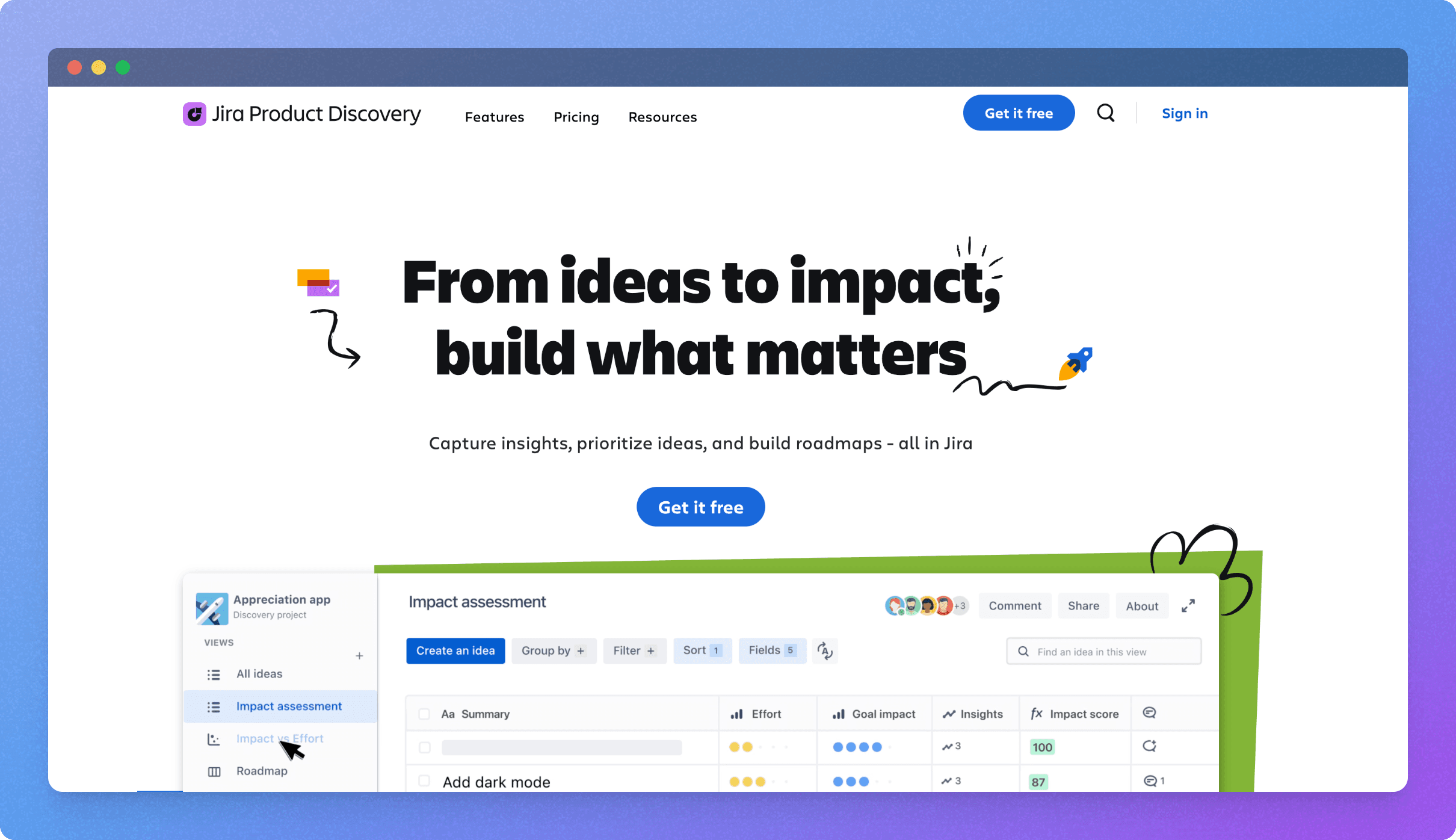
Jira Product Discovery is used to gather insights, prioritize your ideas, and create an overall roadmap for your business. Discovery tools can be connected along with the Delivery tools through your Jira Products. Project and Idea Managers will be charged for their creating capabilities within the system, while Contributors have no charges, and an unlimited number of users can utilize these capabilities.
Key Features
End-to-end delivery tracking
Custom prioritization fields and scoring formulas
Unlimited free contributors
Native integration with Jira software
Custom prioritization frameworks
Custom roadmaps
Pros
Seamless Jira integration
Standalone subscription available
Multiple flexible views
Strong Confluence integration
Cons
No customer-facing public feedback board
No automatic notifications on shipping the features
No in-app feedback widget
Pricing
Plan | Price | Features |
Free | $0 | Up to 3 creators, unlimited contributors, idea management, basic roadmap, Jira integration, Chrome extension |
Standard | $10/creator/month | Everything in Free + unlimited creators, custom prioritization fields, RICE scoring, List / Kanban / Timeline views, stakeholder roadmaps, Confluence integration |
Premium | $25/creator/month | Everything in Standard + cross-team roadmaps, advanced permissions, portfolio-level visibility, AI writing assistance, priority support |
Enterprise | Custom | Everything in Premium + unlimited scale, enterprise security, SSO, advanced admin controls, dedicated support |
10. Productboard
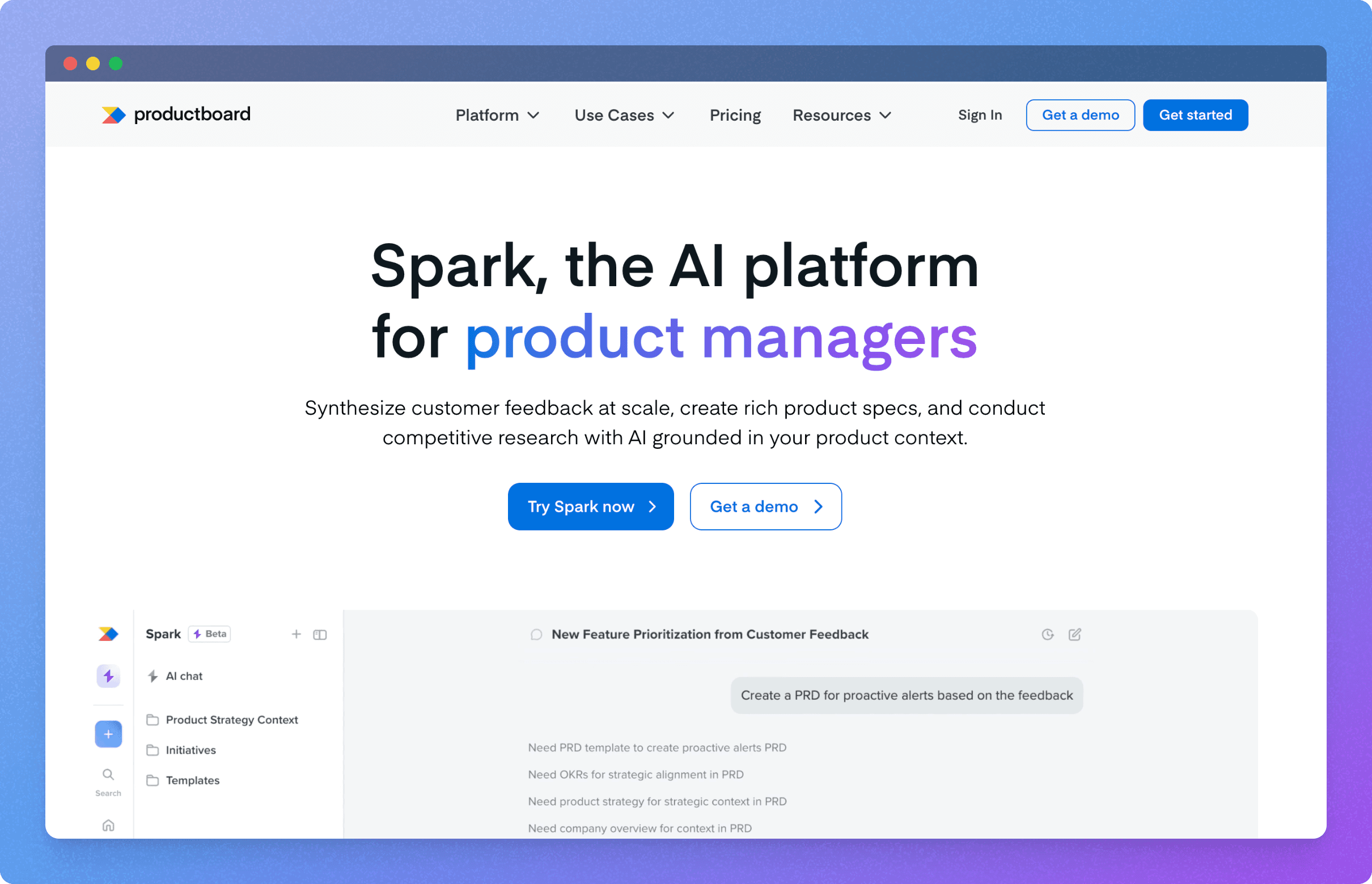
Productboard is an end-to-end product management platform that offers feature request management along with assistance in product planning. It lets you conduct competitive research with AI grounded in your product context. This customer feedback tool helps you scale your product operations and connect delivery frameworks across multiple teams.
Key Features
Dynamic roadmap views with customizing visibility
Centralized feedback from multiple sources
Product planning tools
SaaS tools integration
Trends detection using AI
Data-driven decision making
Customer voting on feature ideas
High-value user comments prioritization
Pros
End-to-end product management
Suitable for enterprise-level organisations
AI capabilities for trends analysis
Powerful prioritization framework
Cons
Difficult to start usage, complex setup
Expensive pricing scales as users grow
No auto categorization
Pricing
Plan | Pricing | Features | Who Is It For |
Free | Free | 50 feedback notes, 1 Teamspace, 1 product portal, limited integrations | Individuals |
Plus | $19 /maker/month, if billed yearly $25 /maker/month, otherwise | 250 feedback notes, portal moderation, feedback loop closing, release planning, etc | For teams who prioritise customer needs |
Business | $59 /maker/month, if billed yearly $75 /maker/month, otherwise | Unlimited feedback notes, 10 objectives, manual customer segments, prioritised email support | For driving real business outcomes |
Enterprise | Contact | Unlimited teamspaces, 3+ product portals, Salesforce integration, SAML SSO & Google SSO | For large organisations |
Feature By Feature Comparison: Top Feature Request Softwares
Tool | AI Capabilities | Feedback Collection | Public Board | Upvoting | Roadmap | Changelog | Close the Loop | Integrations |
ProductBridge | Auto-categorization, duplicate detection, and demand trends | Public/private boards, in-app widget, portal | ✅ | ✅ | ✅ | ✅ | ✅ Automatic | Slack, Intercom, Jira |
Canny | Manual tagging, manual duplicate merging | Public/private boards, in-app widget, Slack, email | ✅ | ✅ | ✅ | ✅ | ✅ Automatic | Jira, Intercom, Salesforce, Slack |
Featurebase | No AI — manual organization | Public/private boards, in-app widget, Intercom, Slack | ✅ | ✅ | ✅ | ✅ | ✅ Automatic | Jira, Intercom, Slack, Zapier |
Savio | No AI — revenue-weighted manual prioritization | Chrome Extension, Intercom, Zendesk, HubSpot, Slack, email, API | ✅ | ❌ | ✅ | ❌ | ✅ Manual | Jira, Shortcut, Intercom, HubSpot, Zendesk |
Upvoty | No AI — manual management | Public/private boards, in-app widget | ✅ | ✅ | ✅ | ✅ | ✅ Automatic | Jira, Slack, Zapier |
Frill | No AI — manual tagging | Public/private boards, in-app widget | ✅ | ✅ | ✅ | ✅ | ✅ Automatic | Jira, Slack, Zapier |
Usersnap | AI sentiment detection and categorization | In-app widget, screenshots, screen recordings, surveys | ✅ | ✅ | ❌ | ❌ | ❌ | Jira, Linear, Azure DevOps, Slack |
Sleekplan | No AI — manual tagging | Public/private boards, in-app widget, NPS surveys | ✅ | ✅ | ✅ | ✅ | ✅ Automatic | Chrome, WordPress, Zapier |
Jira PD | AI writing assistance — Premium only | Internal only — no public customer board | ❌ | ❌ | ✅ | ❌ | ❌ | Jira, Confluence, Jira SM |
Productboard | AI tagging and feedback summarization | Public portal, in-app widget, Intercom, Zendesk, email | ✅ | ✅ | ✅ | ❌ | ✅ Automatic | Jira, Intercom, Zendesk, Salesforce |
Conclusion
Nowadays, managing large volumes of feedback cannot be done manually or even with less automation. Choose the best feature request software that offers strong AI capabilities like ProductBridge, Featurebase, Sleekplan, etc, and based on your budget.
Frequently Asked Questions
What is the best feature request software in 2026?
ProductBridge is the best feature request software for its strong automation capabilities, AI features, and complete feedback closing loop. The platform’s pricing is predictable, unlike some feature request trackers, which increase the pricing as the product scales.
How do you track feature requests effectively?
To track feature requests effectively, use AI powered feature request software like ProductBridge, Featurebase, Sleekplan, etc that auto-categorize and deduplicate across channels. Always close the loop with automatic notifications to users who are interested or requested.
What is feature request management?
Feature request management means to collect, organize, prioritize, and respond to feature requests from users of your product. It helps teams to decide which requests to build first and ship first. It includes auto-notifying users once the requested features are shipped and writing changelogs for the same.
How do feature request management tools collect feature requests from customers?
Many feature request software providers provide public and private user feedback boards, where users can write their feature requests. Also, they combine various platforms like email, Slack, CRM connection, chrome extension, and customer support tools. These tools centralize all these channels into one platform, making them good feature request trackers.
How do you prioritize feature requests?
Feature request pirioritiaztion should be based on both user demand signals and business context. Check the vote count for a higher number of votes. Sort requests by MRR. Score against impact, urgency, and strategic fit. AI-powered feature request software like ProductBridge automates this process.
What is the difference between feature request software and product management?
Feature request software focuses mainly on feedback collection and prioritization. These tools gather user feedback and feature requests, prioritizes them, and allow teams to build roadmaps for developing the important and required features and notifying users after their required feature is shipped.
Some of the best feature request software, like ProductBridge, also offer advanced AI powered features also, to reduce manual work.
Product management tools handle overall product planning, including strategy, roadmap planning, release management and team coordination. Some examples of such tools are Aha! And Productboard.