Bug vs Feature: What's the Difference? (With Examples)
Not sure if it's a bug or a feature? Learn the exact difference, see real examples, and use a 4-question framework to classify any issue.
Product Management

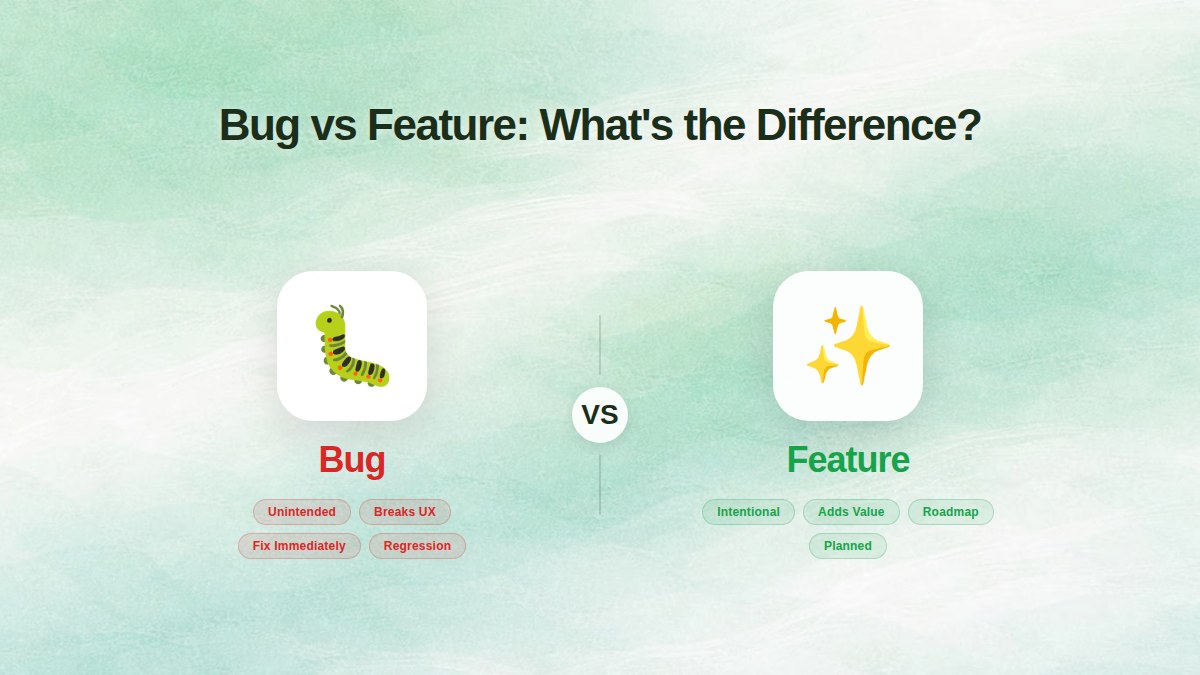
A bug and a feature are not the same, and there is a need to understand this difference. But how do teams differentiate between the two? What is the exact difference between a bug and a feature?
TL;DR – Bug vs Feature Explained Quickly
A bug is an unintentional flaw or error in software that causes it to behave incorrectly or differently from its intended functionality.
A feature is a planned piece of software functionality intended to improve the user experience or meet the user’s requirements. It is intentional.
Quick Comparison: Bug vs Feature
Bug | Feature |
Unintentional | Intentional |
Not a primary business decision | Usually, a business decision |
Fix, accept, or promote | Ship, iterate, deprioritize |
Needs fixing | Adds functionality |
Comes from coding or system errors | Managed through product roadmaps |
Example: File upload fails | Example: Drag-and-drop file upload option |
In a few cases, the difference between a bug and a feature becomes unclear. When users are habituated to the bug, viewing it as an intended feature of the software, then improving or fixing that bug will disrupt their experience.
Then, deciding whether something is a bug or a feature becomes more of a product decision than a technical one.
Key Takeaways
A bug is an unintended error in logic that results in unwanted or unexpected behavior of the software, whereas a feature is developed intentionally to deliver value to users.
Teams understand the intent first, to identify if something is a bug or a feature.
Bugs need to be fixed and are managed through issue tracking systems like Jira.
Features need to be prioritized, developed, tested, and implemented, and are managed through platforms like ProductBridge.
Bug vs Feature in Software Development
If you are still thinking, “It’s not a bug, it’s a feature”, a joke, then you have to think again. Understanding the bug vs feature distinction is significant in serious cases, and understanding this is crucial as it affects software quality, user experience, and development priorities.
Misclassifying a bug as a feature can result in:
Poor user experience
Increased technical debt
Unresolved issues in production
Incorrect functionality of the software
This guide is for all developers, QA engineers, product managers and other software professionals and helps you to understand how the difference between bug and feature affects their responsibilities in the software development life cycle.
Why The Bug vs Feature Distinction Matters?
Understanding the difference between a bug and a feature is crucial because then teams can effectively prioritize tasks. This understanding directly affects the product quality and the task management efficiency.
The bug vs feature categorization is crucial for software teams for:
Critical fix prioritization
Reliable software releases
Efficient development cycles
Clear team collaboration
Since software teams mostly work within limited time and resources, they rely on only accurate classification of issues to ensure a high-quality user experience where bugs no longer appear, and the product behaves as expected by the user.
What is a Software Bug?
A software bug refers to a defect in the program that results in software functioning differently from how it should.
Bugs appear from logic errors in code, unexpected interactions between system components, or some edge cases that were missed during development. The software may behave in an unexpected way or fail to perform a certain action completely.
These bugs are generally identified during testing or real-world usage and can be tracked using certain tools, such as product management or issue trackers like ProductBridge or Jira.
Key Characteristics of a Software Bug
Bugs are unintentionally occurring during development
Results in unexpected or unintended behavior
Bugs are reported and tracked using issue trackers
Affects user experience and needs to be improved
Common Types of Software Bugs
Type of bug | Explanation | Example |
Logical Bug | Occurs due to poorly written code or improper logic | Calculating the estimated arrival time incorrectly because the logic says to add distance instead of travel time |
Functional Bug | Occurs when a certain feature is not behaving as expected | A search bar shows no results despite the existence of matching records |
Security Bug | Occurs when there is a vulnerability that can expose private data | A password reset option allows an unlimited number of attempts without proper authentication |
Usability Bug | Occurs when the user experience is too complex for users to find what they want easily | The button appears only if scrolled, making users think that the button is absent |
Workflow Bug | Occurs when state transitions ot navigation are poorly built | A system allows users to confirm appointments without fixing the time slot first |
Compatibility Bug | Occurs when the application does not work the same across multiple platforms or devices. (mobiles, laptops, tablets, iOS, Android) | The buttons overlap in iOS but not in Android |
Unit Level Bug | Minor-level bug, identified in the initial testing stages of small units of code | Functions returning wrong or unnecessary data |
What is a Software Feature?
A software feature refers to an established means of providing value to users through a software application. The functionality provided is nothing but features through which users can utilize the functionalities offered by the product.
Software features tell about the product’s capabilities and, therefore, how the users will benefit by using that specific product. An example is ‘sending a voice message’ with WhatsApp. This is a feature of WhatsApp that allows users to record them speaking and send it to anyone.
The features expand the capabilities of the product and shape how the product develops over time into a more useful tool.
Key Characteristics of a Software Feature
A feature is planned or implemented deliberately
Features aim to solve user problems or improve the product’s usability
Prioritized based on product strategy or based on various factors
Features are developed and tested. Only then will they be deployed.
How Software Features Are Introduced
Unlike bugs, which are found during testing or usage, software features are introduced in structured workflows.
It follows this structure:
User gets a requirement and requests, along with giving feedback
Teams recognize, prioritize, and do roadmap planning
Market research and competitive analysis
Development based on priority
Testing and deploying the feature to the product
Announcements on the management platform, like ProductBridge
Bug vs Feature: Key Differences
Difference Criteria | Software Bug | Software Feature |
Definition | An unintended error causing unexpected or incorrect behavior | An intended functionality implemented to solve user problems or improve user experience |
Origin | Logic errors in the code, unexpected system interactions | Planning, user demands, or business needs |
Intent | Unintentional | Intentional |
Action | Needs to be fixed | Needs to be developed, tested, and implemented |
Impact | Causes unwanted behavior and disturbs the user experience | Solves user requirements and improves user experience. Improves usability. |
Management | Debugging and issue tracking | Feedback prioritization and product roadmaps |
Priority factors | Based on severity and impact | Based on strategy and user value |
Example | Users do not get notifications even after enabling them | Custom notification preferences setting option |
How to Identify Whether Something is a Bug or a Feature
To identify whether something is a bug or a feature, teams should first understand the intent. Bugs are intended defects, while features are intended improvements.
Ask the following questions to easily differentiate between a bug and a feature;
Was this behavior already designed? If yes, it’s a feature, otherwise a bug
Is this behavior documented in product details? If yes, a feature it is, or else, a bug
Is any other functionality disturbed due to this? If yes, it's a bug, or else, check.
Have users anywhere requested this functionality? If yes, it's a feature, or else, it needs to be fixed
It is a software feature that needs to be developed and implemented if:
Product value is improved by introducing this functionality
Users requested or opined that certain behavior would benefit them
The behavior is documented in the product specifications
User faces ease of use or an improved experience if this is present
It doesn’t behave like an error in the system
If the answers to any of the above situations are No, then keep checking to understand it better.
For example, consider this scenario where, even when there are a number of matching products, the search bar still returns, ‘No products.‘
Here, despite the existence, there is no result for the user. This is clearly a bug. Because there is a logic error in coding, where despite returning all the products matching the name searched by the user, it returns no elements.
This is a bug because it is giving unexpected behavior and also dissatisfying the user.
Consider this scenario where, while the user types a product name, the search bar tries to correct the spelling errors automatically or suggest related products automatically. This makes the user's job easier, and the user will benefit. This is considered a feature.
Here, the feature would be ‘suggest related products and auto-correct spelling errors’. This is appreciated by the user, and hence it is a feature. It improves user experience, works as the code is written, and is not an error.
When Bugs Become Features
There are cases where bugs turn into features and teams decide to keep the functionality similar, as users are not affected by it, or fixing the bug can change the existing functionality that the users are already habituated to.
If the bug has been unresolved for a long time, but somehow the bug doesn’t affect the user experience, then the user gets comfortable with the bug, making them think that it is also one of the features.
Then, the user’s expectations of how the product would work would be different. Later, when the software team realises there is a bug and it needs to be fixed, fixing it would change the functionality, which would confuse users.
So here, a bug actually appears like a feature. In such situations, teams decide to leave the bug as it is, allowing it to function like one of the features.
A bug may turn into a feature when:
Users can complete their tasks effectively with the existing functionality
Fixing the bug can disrupt user workflows
The bug does not cause any security threat
Best Practices to Manage Bugs and Features
Teams usually manage bugs through debugging and issue tracking, and features through product planning, strategy, feedback prioritization and development.
For Development Teams
Development teams identify, track, and resolve software bugs. This increases the system’s reliability.
Track bugs using issue tracking tools
Dedicate a backlog to bugs to track unresolved issues
Try automated testing to detect issues early
Do regular code reviews and debugging
Define clear bug reporting standards
For Product Teams
Product teams plan, prioritize, and evaluate software features to see if the product aligns with user needs and business goals.
Analyze user feedback and research on their requirements
Pioritize feature based on user value and product strategy
Maintain an organized feature roadmap
After release, track and document feature adoption and usage metrics
Collaborate with development teams to understand features better
So, developers develop the product, so mainly they also focus on resolving the issues because the main origin of bugs is from the coding errors, while product managers worry about features, test them, and understand their part, and work on tracking and improving them by collaborating with the development team.
Conclusion
Before deciding whether something needs to be fixed, teams should understand if making any improvement will alter the existing functionality and if it will really be useful for the product growth. Bugs can be tracked and managed using issue tracking systems and features can be managed through ProductBridge.
Frequently Asked Questions
What is the difference between a bug and a feature?
In software, a bug is an unexpected error that makes the product behave in a different manner than expected, whereas a feature is a part of the product’s functionality that might satisfy users’ requirements or help users manage their tasks effectively. Features are intentional development tasks introduced in the software.
Can a bug become a feature?
Yes, in some cases, a bug can become a feature. Such cases include situations where the bug itself aligns with the user’s needs, then that bug is like a feature. When users find the bug useful to them, then teams may decide to keep it as one of the features.
Are all unexpected behaviors considered bugs?
No. Not always. Sometimes the unexpected behavior aligns with the user’s needs. So if it satisfies what the user is expecting, then that will no longer be a bug. It will be considered more as a feature.
What tools are used to manage bugs and features?
Bugs can be tracked using issue tracking systems like GitHub or Jira, and features are usually managed through product management platforms like ProductBrige, where you can work with roadmaps, feedback collection and changelogs.
Do bugs always need to be fixed?
Mostly, bugs should be fixed. But before working on fixing the bug, it is better to understand clearly if fixing the bug will affect user experience in any possible negative way. If the users had been okay with the bug, or it was actually helping them out, then you may not need to fix the bug that importantly.
How do you identify whether something is a bug or a feature?
To identify whether something is a bug or a feature, check if the functionality it is giving is actually documented in the product specification, or if the behavior is expected. If it is an unintended one, it will probably be a bug. Or if it is helping the product grow, then it can be a feature.
Who decides whether something is a bug or a feature?
Teams collaborate, including the developers, product managers, and QA engineers, to analyze their individual parts. Like, developers check technical behavior, QA verifies if the functionality aligns with expectations, and product managers decide if the behavior matches the product goals.
So altogether, teams collaborate and analyze if something is a bug that needs to be fixed or a feature that needs to be implemented.